Company
History since 1960
From a service workshop in Wesel to the plant in Hünxe — and, with HELLMERS, a vehicle manufacturing tradition dating back to 1811.
KROLL and HELLMERS
Two traditions, one group
Seeking a more versatile product range, a stronger presence and even greater flexibility, KROLL Fahrzeugbau-Umwelttechnik GmbH acquired 100% of the shares in HELLMERS GmbH Fahrzeugbau of Wittstock/Brandenburg with effect from 1 June 2005.
Since this merger, the two companies have been jointly strengthening their position in the German and European markets — for sustainable, continuous growth.
Milestones
KROLL in three dates
1960Founded in Wesel
1980first WRS 1 with water recycling
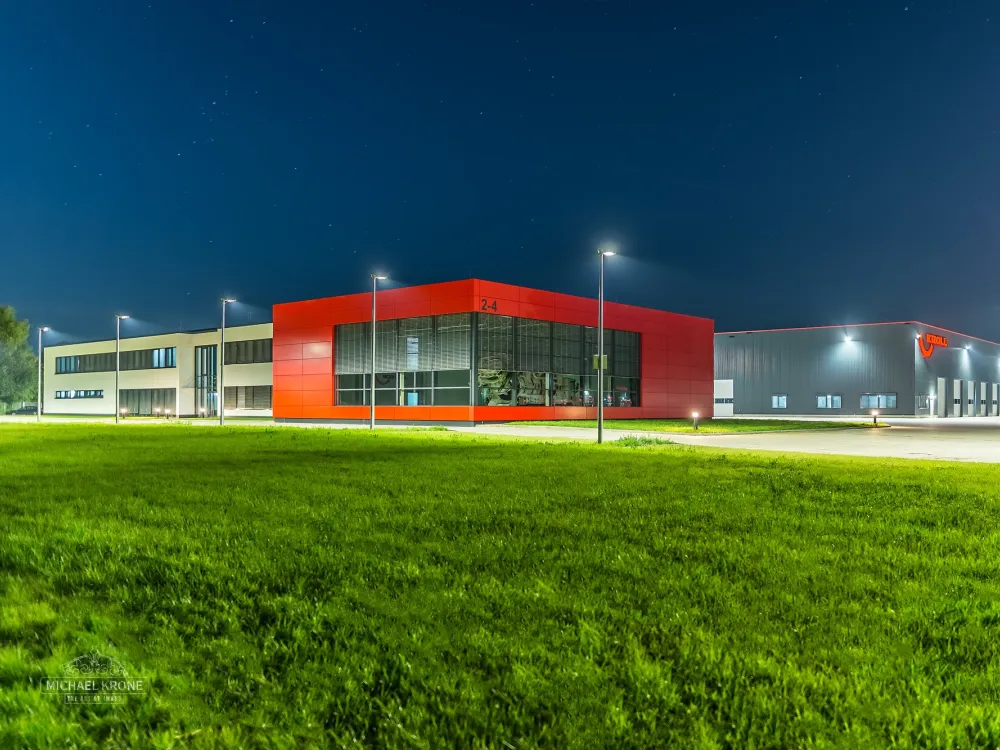
2015Move to the new Hünxe plant
KROLL history
From GABLER & Co. to KROLL Fahrzeugbau-Umwelttechnik GmbH
1960–1982: Gabler & Co. in Wesel
- 1960 — Mr Gabler and Mr Nitz found GABLER & Co. in Wesel on the Lower Rhine, on the premises of Pohl & Löll (now MCW) — as a service workshop for KUKA (Keller und Knappich, Augsburg) refuse collection vehicles and vacuum tankers.
- 1961 — Foundation stone laid for the company site on Rudolf-Diesel-Straße in Wesel.
- 1964 — The first vacuum tanker of the company’s own manufacture.
- 1973 — Inauguration of the newly built administration building.
- 1978 — Construction of a larger, more modern production hall.
- 1979 — The first rotary drum refuse collection vehicle leaves the plant.
- 1980 — The first combined suction and jetting vehicle with water recycling leaves the plant: the WRS 1.
- 1980 — Gabler GmbH & Co. KG launches a refuse collection vehicle under its own name. This became possible when the contract with Keller & Knappich expired, which had required all sales to go through the Augsburg market leader.
- 1982 — Development of a new type of refuse collection vehicle: a new drive system and a fully enclosed refuse hopper reduce noise levels by up to 80% compared with previous models.
- 1982 — The first bin washing vehicle is produced.
1983–2004: KROLL and ROTHENBERGER
- 1983 — KROLL GmbH of Hamburg/Reinbek, founded in 1946 as Bruno Kroll & Co. OHG, takes over the insolvent GABLER & Co. The company is renamed KROLL Fahrzeugbau GmbH.
- 1983 — The first tunnel washing vehicle is delivered to the Hamburg motorway maintenance depot. Production of refuse collection vehicles is discontinued.
- 1989 — ROTHENBERGER AG of Kelkheim takes over KROLL Wesel.
- 1990 — Acquisition of the former East German combine VEB Spezialfahrzeugwerke in East Berlin, the largest manufacturer of waste disposal vehicles in the former GDR — subsequently SFW Spezialfahrzeuge-Umwelttechnik GmbH, later KROLL Berlin, specialising mainly in sweepers.
- 1992 — Acquisition of DISAB in Sweden, a special vehicle manufacturer of stationary and mobile pneumatic conveying systems.
- 1996 — Sale of the shares in DISAB.
Since 2005
Group and new plant
With HELLMERS, Kutschke and the move to Hünxe, KROLL grows into a group of companies with a new production facility.
- 012005Acquisition of 100% of the shares in HELLMERS GmbH Fahrzeugbau in Wittstock.
- 022007With effect from 1 May 2007, KROLL takes over the business operations of Kutschke Fahrzeugbau GmbH in Hünxe, his GmbH in Hünxe and Kutschke aur GmbH in Landsberg.
- 032008Together with HELLMERS, KROLL is the market and innovation leader in Germany for liquid waste disposal and sewer cleaning vehicles and equipment.
- 042015Move to the newly built plant in Hünxe, the most modern production facility for liquid waste vehicle technology in Europe.
HELLMERS history
HELLMERS — vehicle manufacturing since 1811
1811–1952: From wheelwright’s shop to municipal vehicles
- 1811 — Hans-Barthold Hellmers founds a wheelwright’s shop.
- 1822 — Entered in the Hamburg State Archives as Herm. J. Hellmers Wagen-, Pferdegeschirr- und Sattelfabrik, a maker of carriages, harnesses and saddles.
- 1900 — Shortly before the turn of the century, Paul Hermann Adolph Hellmers specialises in snowploughs, street sprinklers and sweepers.
1953–2000: Combined suction and jetting vehicles and sewer cleaning vehicles from Hamburg
- 1953 — A site on Billbrookdeich in Hamburg is acquired and developed as the company’s premises. The company now concentrates on combined suction and jetting vehicles and sewer cleaning vehicles.
- 1958 — The first combined high-pressure jetting and vacuum vehicle, “der Kombi”, leaves the company site.
- 1964 — Construction of the first “Allstrahl”: a body that uses a single high-pressure pump both to jet sewers and — via a venturi system — to extract material.
- 1965 — New company name: Herm. J. Hellmers GmbH Fahrzeugwerk.
- 1979 — The first “Wassermeister” goes into service: a high-pressure jetting and vacuum vehicle with additional continuous waste water treatment.
- 1988 — The first “Ölmeister” is developed and built for the mobile separation of oil-water mixtures.
- 1990 — After reunification, Hellmers is one of the first Hamburg companies to launch concrete initiatives in the new federal states: acquisition of a production site in Wittstock (Brandenburg) and a service site with mobile customer service near Dresden (Saxony).
- 1996 — Development of the “HellmOX system” for consumable-free and maintenance-free odour removal from the exhaust air of the vacuum system.
- 1997 — The first dewatering container system (“ECS”) for the mobile dewatering of sludge is handed over to a customer.
Since 2001: HELLMERS GmbH Fahrzeugbau in Wittstock
- 2001 — Owing to better conditions and development opportunities, bodies are now built exclusively in Wittstock. The company now trades as HELLMERS GmbH Fahrzeugbau.
- 2005 — In June, KROLL Fahrzeugbau-Umwelttechnik GmbH of Wesel acquires 100% of the shares. Since then, both companies have offered their products nationally and internationally, making use of synergies.
KROLL today
How we work today — from the company to production at the Hünxe plant.